
How to Become a Chef After 12th: Courses, Fees and Salary in India (2026)
To become a chef after 12th in India, choose a...
Read More →
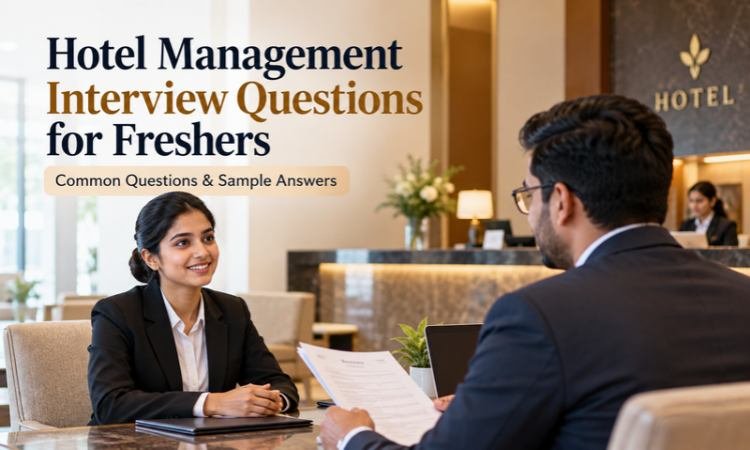
Your first hotel interview can feel scary. You may have finished your course and your internship, but sitting in front of an interviewer is a different kind of test.
Here is the good news. Hotels do not expect freshers to know everything. They want to see a polite person who communicates clearly, works well in a team, stays calm and is ready to learn. In this guide, we cover the most common hotel management interview questions, with simple sample answers, department-wise technical questions and practical tips you can use right away.
If you are still choosing a career in hotel management, this guide will also show you what hotels expect from new joiners.
Most of the hotel interviews have in general three parts:
You don’t need those perfect answers. You have to be clear, honest, and polite here; that actually shows your judgement.
Interviewers watch how you speak as well as behave as much as what you say. These are the things that they check:
The process is different for different hotels, but most of the freshers have to go through these steps:
Colleges with strong placements usually arrange mock interviews and practical tests before campus drives. If your college does this, take full advantage of it. Practice makes a big difference to your confidence.
Do not memorise these word by word. Read them, understand the idea and say them in your own words.
“My name is [Name]. I have completed my [course] from [college]. During my training I worked in [department] and learned about guest service and teamwork. I enjoy working with people and I want to start my career in a hotel where I can learn from experienced seniors.”
Tip: Keep it under one minute. Do not read your whole CV.
“I like working with people, and hotel work is never boring. Every day brings new guests and new situations. I want to build my skills in a professional environment.”
Tip: Be real. If you love cooking or guest interaction, say that.
“I would like to start in the front office because I enjoy talking to people and solving small problems. During my training I handled check-ins and I liked the work. But I am ready to learn in any department where the hotel needs me.”
Tip: Name one department and give one honest reason. Showing flexibility is a plus.
“I may not have long experience, but I am punctual, willing to learn and ready to follow instructions. I completed my internship training and I understand the basics. I will work hard and listen carefully to my seniors.”
“My strength is that I am disciplined and I work well in a team. My weakness is that I sometimes feel nervous when I speak in front of new people. I am working on it by practising mock interviews.”
Tip: Choose a real weakness and show how you are fixing it. Never say “I have no weakness.”
“I read about your hotel before coming. I know about your rooms, restaurants and the type of guests you serve. I also checked the role I applied for, and I would like to learn how your team maintains such high standards.”
Tip: Visit the hotel website the night before. Know the brand, the restaurants and the location.
“Yes. I understand that hotels work 24 hours, so morning, evening and night shifts are part of the job. I will be punctual and I know proper handover is important.”
Tip: Be honest. If you have a real limitation, say it clearly instead of promising something you cannot do.
“Yes, I am open to relocating. I see it as a chance to learn and grow. I would like to know about accommodation and joining details.”
“I am a fresher and my main goal is to learn. I would expect a salary according to the hotel’s standard for this role, and I am open to discussing it.”
Tip: Do not name a big number. Let the hotel make the first offer.
“I want to build strong experience in my department, learn all the standard procedures and take on more responsibility. In time I would like to become a supervisor.”
Tip: Be realistic. Do not say you will be a general manager in five years.
Many hotels ask, “Tell me about a time when you handled a difficult situation.” The easiest way to answer is the STAR method:
Example: “During my internship at the restaurant, a guest said his soup was cold (Situation). I had to make sure he was happy (Task). I apologised, told my captain and requested the kitchen to prepare a fresh bowl (Action). The guest thanked us and finished his meal (Result).”
If you do not have work experience, use an example from your college practicals, an event or your internship.
Other situation questions you may get:
This is where many freshers lose marks. Revise the basics of your department well.
What does the front office do?
It handles reservations, check-in, check-out, guest queries, billing and coordination with other departments. It is the first and last point of contact for guests.
What is the difference between a reservation and a walk-in?
A reservation is booked in advance. A walk-in guest arrives without a booking, and you can accept them only if a room is available.
What are ADR and RevPAR?
ADR (Average Daily Rate) is room revenue divided by the number of rooms sold. RevPAR (Revenue Per Available Room) is room revenue divided by the total rooms available.
What is overbooking?
Accepting more bookings than available rooms, expecting that some guests will cancel or not show up. Hotels manage it carefully to avoid problems.
What is a night audit?
It is the end-of-day process where the night auditor checks and balances all guest bills and transactions, then closes the day’s accounts.
Know these too: FIT (individual travellers) and GIT (group travellers), PMS (property management system), and the types of rooms: single, double, twin, suite.
What are the main duties of housekeeping?
Keeping guest rooms, bathrooms, corridors and public areas clean, managing linen, handling lost property and reporting maintenance problems.
What do these room status codes mean?
What will you do if you find a guest’s valuable item?
Do not keep it or move it around. Report it to your supervisor at once and record it in the lost-and-found register.
Why is a room checklist useful?
It helps staff follow the same standard every time and avoid missing small details.
What is mise en place?
A French term meaning “everything in its place.” You prepare and arrange all ingredients and tools before cooking starts, so service runs smoothly.
What is the difference between boiling and simmering?
Boiling is cooking in liquid at around 100°C with large, fast bubbles. Simmering is gentler, at roughly 85–95°C, with small bubbles. It is used for stocks and slow-cooked dishes.
Name the five mother sauces.
Béchamel, velouté, espagnole, hollandaise and tomato.
How do you stop cross-contamination?
Keep raw and cooked food separate, use clean and colour-coded boards and knives, wash hands properly and store food at the right temperature.
What is FIFO?
First In, First Out. Older stock is used first, so food does not expire.
What is the temperature danger zone?
Roughly 5°C to 60°C, where bacteria grow fastest. Food should not stay in this range for long.
What is the brigade system?
The kitchen hierarchy, from the executive chef down to the commis, where each person has a clear role.
What is the difference between à la carte and table d’hôte?
À la carte lists each dish with its own price. Table d’hôte is a set menu at a fixed price.
What is the sequence of service?
Greeting and seating, water and menu, taking the order, serving food, checking on the guest, clearing, presenting the bill and a polite farewell.
What will you do if a guest mentions a food allergy?
Take it seriously, note the details, tell the kitchen and your supervisor, and never promise a dish is safe until the kitchen has confirmed it.
What if a guest receives the wrong order?
Apologise, confirm what was ordered, inform your captain and the kitchen, and bring the correct dish quickly.
Luxury hotels look closely at small details. Keep these points in mind:
If a guest speaks a different language, stay patient, use simple words and ask a colleague for help if needed. Never pretend to understand something important.
The day before:
On the day:
At the end, you will often hear, “Do you have any questions?” Always ask one or two:
Avoid asking about leave or salary first. Ask about learning and growth.
Hotels hire people who are polite, honest, hardworking and ready to learn. You do not need to be perfect. If you know the basics of your department, practise the common hotel management interview questions in this guide and stay calm, you can make a strong first impression.
Start practising today. Say your answers out loud, do a mock interview with a friend and revise your department notes. With the right preparation, your first hotel interview can be the first step of a long and successful hospitality career.
Is work experience compulsory for a hotel job as a fresher?
No. Many entry-level roles accept candidates with a diploma or degree and internship training. Practical skills and attitude matter a lot.
How should a fresher introduce themselves?
Say your name, your qualification and college, mention your training or internship and share one or two strengths. Keep it short and natural.
What if my English is not very good?
Use short, clear sentences. Practise common answers aloud or with a friend. Hotels value clear and polite communication more than difficult words.
What should I wear for a hotel interview?
Wear clean, formal clothes: a shirt and trousers with formal shoes, or a formal suit or saree. Follow any dress code the hotel mentions.
Which course helps most in getting a hotel job?
A practical, well-structured course with internships helps the most. A diploma in hotel management or a BHM degree both give you the basics, and hands-on training makes interviews much easier.
How many questions should I prepare?
Prepare 15 to 20 core questions: your introduction, strengths, guest handling and 5 to 6 technical questions from your own department.

Amazon Institute of Hotel Management Noida — preparing future leaders for the global hospitality industry since 1997 through practical, industry-aligned training.
Fill in your details and our admissions team will get in touch with you shortly.